Some of mental health diagnosis in Special care counseling
20 Mental health diagnosis terms
Hi, it's Marianne again! So, today, I had to choose a topic that interests me, to write some definitions. Like you know, I study in Special Care Counseling and there are a lot of mental health diagnosis and people do not talk about it because it is a delicate subject. But, there are more people who are affected by it than you think. And that is the principal reason why I choose to find you some definition of diagnosis. For my source, I use Wikipedia for my research.
Adjustment disorder
noun
An adjustment disorder (AJD) occurs when an individual has significant difficulty adjusting to or coping with a significant psychosocial stressor.
Example: Diagnosis of adjustment disorder is quite common.
en: Trouble de l'adaptation
Alcoholism
noun
Alcoholism, also known as alcohol use disorder (AUD), is a broad term for any drinking of alcohol that results in mental or physical health problems.
Example: Alcoholism is a dependence.
en: Alcoolisme
Anorexia
noun
Anorexia, often referred to simply as anorexia, is an eating disorder, characterized by low weight, food restriction, fear of gaining weight, and a strong desire to be thin
Example: Many people with anorexia see themselves as overweight.
en: Anorexie
Anxiety
noun
Anxiety is an emotion characterized by an unpleasant state of inner turmoil, often accompanied by nervous behaviour such as pacing back and forth, somatic complaints, and rumination.
Example: Anxiety is more than just stress.
en: Anxiété
Attachment disorder
noun
is a broad term intended to describe disorders of mood, behavior, and social relationships arising from a failure to form normal attachments to primary care giving figures in early childhood.
Example: The term attachment disorder is used to describe emotional and behavioral problems of young children, and also applied to school-age children, teenagers, and adults.
en: Trouble de l'attachement
Attention deficit hyperactivity disorder
noun
Attention deficit hyperactivity disorder (ADHD) is a mental disorder of the neurodevelopmental type. It is characterized by difficulty paying attention, excessive activity and acting without regards to consequences, which are otherwise not appropriate for a person's age.
Example: Some individuals with attention deficit hyperactivity disorder also display difficulty regulating emotions.
en: Trouble du déficit de l'attention avec hyperactivité
Autism spectrum
noun
It is a developmental disorder of variable severity that is characterized by difficulty in social interaction and communication and by restricted or repetitive patterns of thought and behavior.
Example: Someone who has autism spectrum has difficulties with changes.
en: Trouble du spectre de l'Autisme
Bipolar disorder
noun
Bipolar disorder (BPD or BD), previously known as manic depression, is a mental disorder that causes periods of depression and abnormally elevated moods. If the elevated mood is severe or associated with psychoses, it is called mania; if it is less severe, it is called hypomania.
Example: Other mental health issues such as anxiety disorders and substance use disorder are commonly associated with bipolar disorder.
en: Trouble bipolaire
Borderline personality disorder
noun
Borderline personality disorder (BPD), also known as emotionally unstable personality disorder, is a mental illness characterized by a long-term pattern of unstable relationships, a distorted sense of self, and strong emotional reactions.
Example: Someone who has a borderline personality disorder has often other disorders.
en: Trouble de la personnalité borderline
Bulimia
noun
Bulimia, also known as simply bulimia, is an eating disorder characterized by binge eating followed by purging.
Example: Both, anorexia and bulimia can be associated with serious biological.
en: Boulimie
Depression
noun
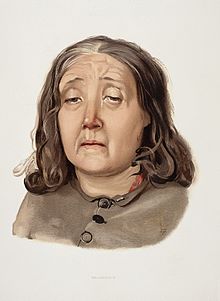
It is a mental disorder characterized by at least two weeks of low mood that is present across most situations. It is often accompanied by low self-esteem, loss of interest in normally enjoyable activities, low energy, and pain without a clear cause.
Example: Some people have periods of depression separated by years in which they are normal, while others nearly always have symptoms present.
en: Dépression
Developmental language disorder
noun
Developmental language disorder (DLD) is identified when a child has problems with language development that continue into the school age and beyond.
Example: The term developmental language disorder (DLD) was endorsed in a consensus study involving a panel of experts (CATALISE Consortium) in 2017.
en: Trouble développemental du langage
Down syndrome
noun
Down syndrome (DS or DNS), also known as trisomy 21, is a genetic disorder caused by the presence of all or part of a third copy of chromosome 21. It is usually associated with physical growth delays, mild to moderate intellectual disability, and characteristic facial features.
Example: Down syndrome is one of the most known syndrome
en: Trisomie 21
Intellectual disability
noun
Intellectual disability (ID), also known as general learning disability and mental retardation, is a generalized neurodevelopmental disorder characterized by significantly impaired intellectual and adaptive functioning. It is defined by an IQ under 70, in addition to deficits in two or more adaptive behaviors that affect everyday, general living.
Example: Intellectual disability affects about 2–3% of the general population.
en: Déficience intellectuelle
Obsessive–compulsive disorder
noun
Obsessive–compulsive disorder (OCD) is a mental disorder in which a person feels the need to perform certain routines repeatedly (called "compulsions"), or has certain thoughts repeatedly (called "obsessions"). The person is unable to control either the thoughts or activities for more than a short period.
Example: The cause of obsessive-compulsive disorder is unknown.
en: Trouble obsessionnel compulsif
Oppositional defiant disorder
noun
Is listed in the DSM-5 under Disruptive, impulse-control, and conduct disorders and defined as "a pattern of angry/irritable mood, argumentative/defiant behavior, or vindictiveness" in children and adolescents.
Example: The oppositional defiant disorder gets slowly away when the person grow up.
en: Trouble de l'opposition
Pathological lying
noun
pathological lying has been defined as "falsification entirely disproportionate to any discernible end in view, may be extensive and very complicated, and may manifest over a period of years or even a lifetime".
Example: There are two kinds of pathological lying.
en: Mythomanie
Stroke
noun
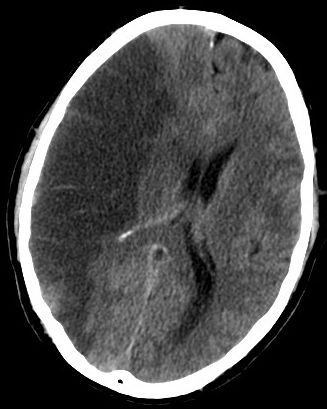
A stroke is a medical condition in which poor blood flow to the brain results in cell death. There are two main types of stroke: ischemic, due to lack of blood flow, and hemorrhagic, due to bleeding. Both result in parts of the brain not functioning properly.
Example: A stroke often requires emergency care.
en: Accident vasculaire cérébral
Tourette syndrome
noun
Tourette syndrome is a neurodevelopmental disorder with onset in childhood, characterized by multiple motor tics and at least one vocal (phonic) tic.
Example: The Tourette syndrome is often accompanied by other diagnosis like anxiety.
en: Syndrome de Gilles de la Tourette
Traumatic brain injury
noun
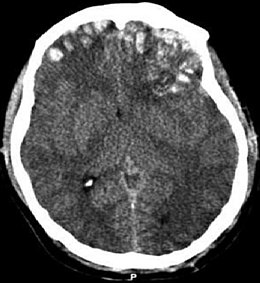
Traumatic brain injury (TBI), also known as intracranial injury, occurs when an external force injures the brain. It can result in physical, cognitive, social, emotional, and behavioral symptoms, and outcome can range from complete recovery to permanent disability or death.
Example: Traumatic brain injury causes a lot of damage.